
Sri Krishna Janmashtami- The divine appearance of the Supreme Lord
14 AUG, 2025
Sri Krishna Janmashtami is the divine appearance of the Supreme Personality of Godhead, Sri Krishna, observed on the eighth day of the waning moon in Bhadrapada. Lord Krishna is unborn and does not take birth like us, but His appearance is like that of the sun- always present, yet unseen. The sun exists long before it rises and continues to exist even after it sets. In the same way, Lord Krishna existed before His divine manifestation on Earth and continues to exist eternally.
Why does the Lord appear?
According to Bhagavad Gita (4.8) Krishna appears for the deliverance of the pious and to destroy the miscreants. But above all, His divine appearance is meant to give pleasure to the hearts of His devotees, reciprocating with their love and devotion.
Towards the end of Dwapar Yuga, when Mother Earth, Bhumidevi, was weighed down by the oppression of demonic kings and the entire world was in turmoil, she took the form of a cow and approached Lord Brahma. Seeking guidance, Lord Brahma brought her to the Supreme Lord Vishnu, on the shores of Shvetadvipa, accompanied by the demigods. Upon hearing the plea of Bhumidevi and the demigods, the Lord appeared to vanquish the demoniac rulers and protect His devotees. In this way, the Lord appears to fulfil this divine purpose.
Additionally, as per Vedic literature, the ultimate goal of human life is to transcend the cycle of repeated birth and death and return to the spiritual world, our original home. The Lord appears in this world to guide us back to that eternal abode, Vaikuntha. The Lord performs many wondrous activities that captivates the souls wandering in this material world, drawing them towards Him. Eventually, such pious souls, enchanted by the Lord’s name, form, and activities, return to the Vaikuntha planets.
The advent of the Supreme Lord
Krishna appears in this material world by His own divine will, unlike us, who are bound by the laws of material nature and forced to take birth as a result of the reactions to our past actions. Krishna does not appear like ordinary human beings. He first manifested before Mother Devaki and Vasudeva, entering the heart of Vasudeva, then into Devaki’s heart, and finally into her womb. During Devaki’s pregnancy, she became radiant with a divine effulgence. The demigods would visit her, offering prayers and paying their respects.
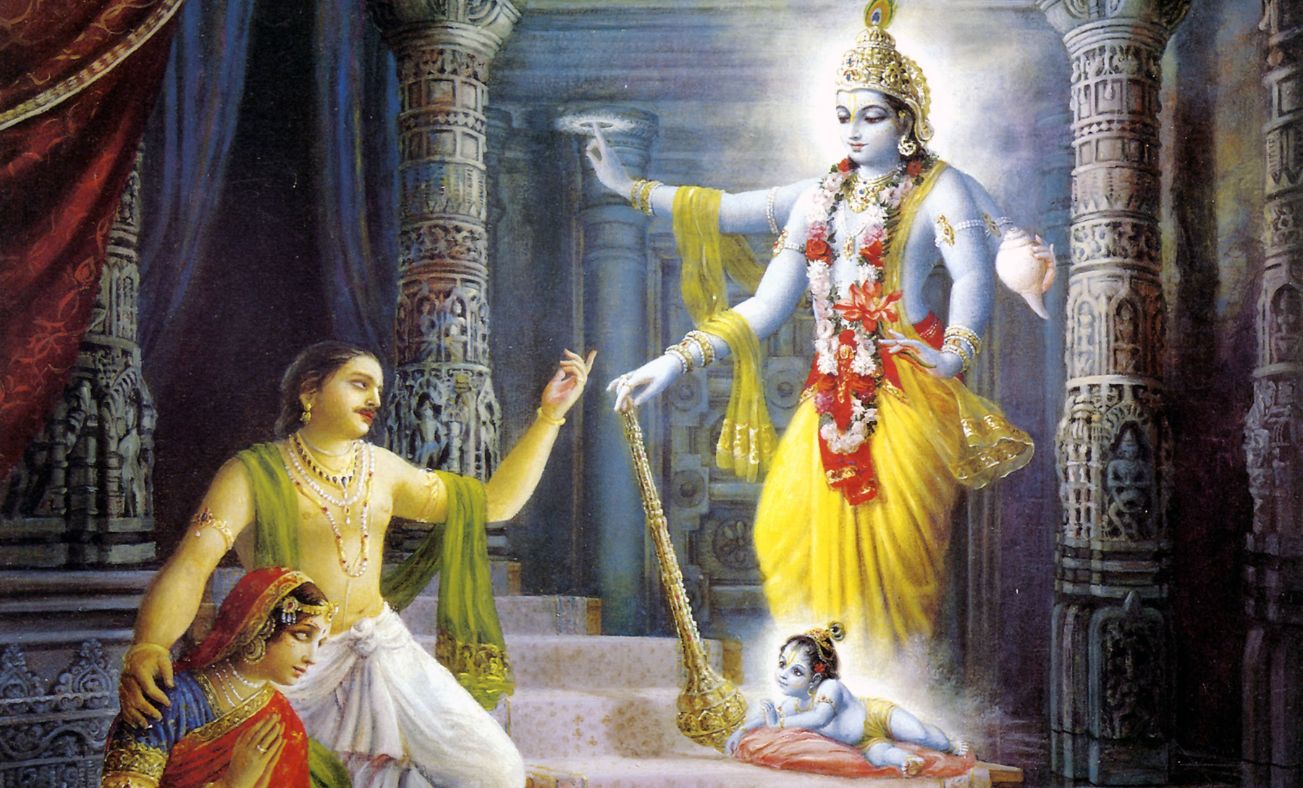
At the hour of midnight, the Lord appeared before Vasudev and Devaki in His magnificent four-armed Vishnu form—adorned with a golden helmet, shining ornaments, the Kaustubha Mani, and a Pitambar-dhoti. Overcome with concern for their child’s safety, Vasudev and Devaki requested Him to hide this divine form. The Lord, smiling, assured them, “Do not worry, I am the Supreme Personality of Godhead. Now take Me to Gokula and exchange Me with Nanda and Yashoda’s daughter.” Instantly, He transformed into a beautiful, enchanting baby, full of innocence, calming His parents’ hearts.
Meanwhile, in Gokul, Yashoda had given birth to a daughter, yet no one knew of it by the Lord’s divine arrangement. As Vasudev prepared to leave, the prison doors and chains opened automatically, and the guards fell into a deep sleep. Passing through each door, Vasudev finally stepped out of the prison. It was the second month of the rainy season, and the Yamuna flowed full. Entering the river under heavy rain, Vasudev saw the waters rise higher and higher, forcing him to lift the basket above his head. Ananta Shesha emerged, spreading his mighty hoods above, shielding the Lord and Vasudev from the pouring rain. Actually, Yamuna was not flooding, she rose in eagerness to touch the lotus feet of the Lord. Then baby Krishna put His tiny foot outside and touched the waters, and Yamuna instantly became an ankle deep.
Reaching Gokula, Vasudev silently exchanged Krishna for Yashoda’s daughter, Mahamaya herself, and returned. At dawn, the village woke at the chirping of birds. Yashoda’s nurse entered her quarters and gasped at the sight—a beautiful blackish boy like a monsoon cloud, with curly black hair, lotus-petal shaped eyes, and delicate fingers, playing with His own hair. Overjoyed, Mother Yashoda embraced the child, and Nanda Maharaj was so filled with happiness that he nearly fainted. The entire village erupted in celebration—preparing grand feasts, distributing charity, singing, and dancing in ecstasy. Thus, the joyous festival of Nandotsava was observed the very next day.
This description of Krishna's divine appearance and performing extraordinary activities reminds us that His birth and activities are all transcendental, as stated in the Bhagavad Gita (4.9) ‘janma karma ca me divyam.’
How should we celebrate Janmashtami?
The best way to celebrate Janmashtami is by expressing our gratitude to Lord Krishna for appearing in this material world for our sake. His divine presence gives us the opportunity to perfect our lives and return to the spiritual realm. We can deepen our spiritual practices by chanting Hare Krishna, singing kirtans and bhajans, reading about Krishna's pastimes, and if possible, fasting according to our capacity. The fast is broken at midnight.
Visit an ISKCON temple nearest to you and take part in the festivities. Devotees engage in singing bhajans and kirtans throughout the day. Various discourses on Krishna’s pastimes are also arranged. The deities are dressed in new garments, and a variety of bhogas are offered to the Lord. The highlight of the celebration is the midnight abhisheka, where the deities are bathed with water, milk, ghee, honey, and different fruit juices which is distributed to all those present as Charanamrita, in the end.
On 16th August 2025, let us come together to celebrate the divine appearance of Lord Krishna with love, devotion, and gratitude. By embracing His teachings and deepening our spiritual practices, we invite Lord Krishna’s blessings into our lives.