Navaratri- Honouring Mother Durga
22 SEP, 2025
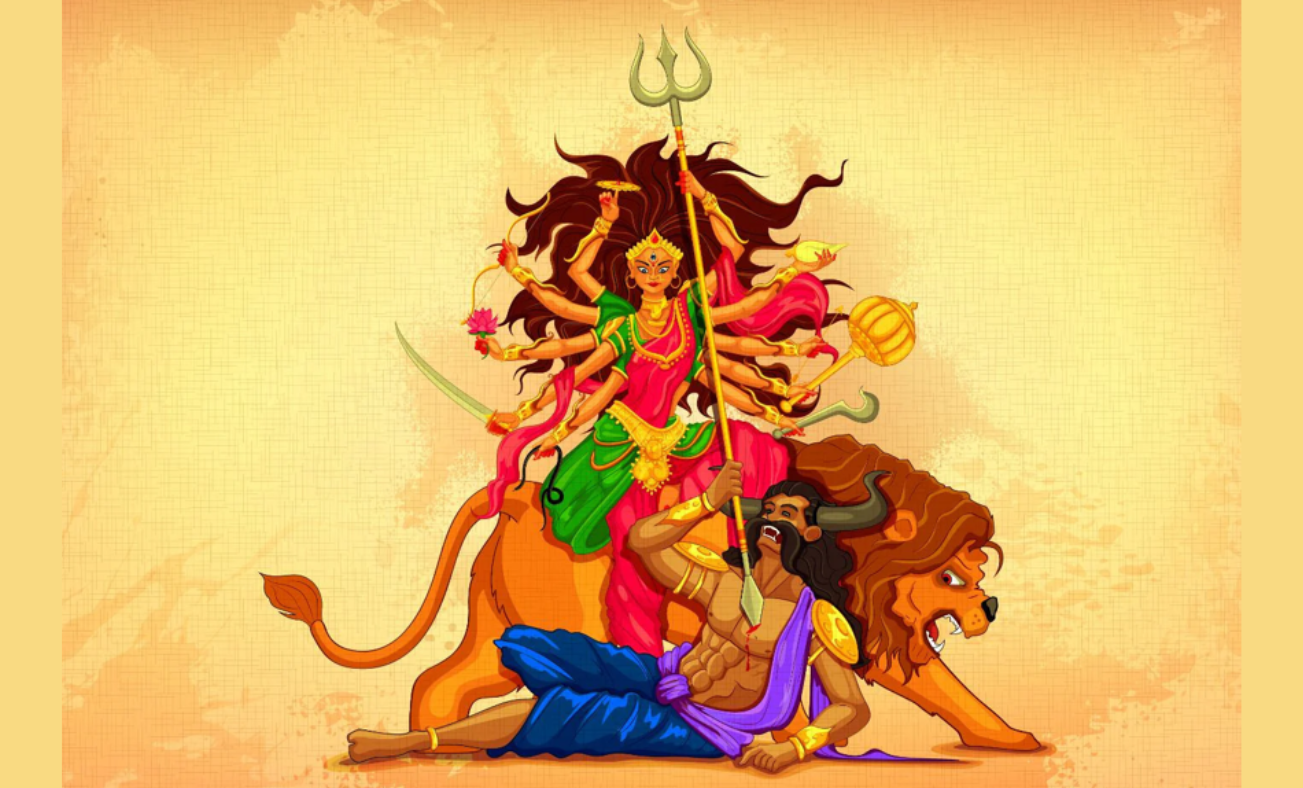
The first day of the Shukla-paksha in the month of Ashwin marks the beginning of Navratri festival. The word “Navaratri” literally means “nine nights.” These nine nights are observed in honour of Mother Durga, remembering her glorious victory over the demon Mahishasura.
What is Navaratri?
The pastime of Navaratri is centered on the nine-day battle between Mother Durga and Mahishasura. Mahishasura, the grandson of Kashyapa Muni, performed severe austerities to please Lord Brahma. When Brahmaji appeared, Mahishasura asked for the boon that he could not be killed by any man or demigod. However, Mahishasura, in his arrogance and overconfidence, had left out a very important part, he did not specify that a woman couldn't kill him. Proud of this benediction, Mahishasura began tormenting the universe. To protect the world, the combined energies of Brahma, Vishnu, and Shiva manifested as Goddess Durga. After nine nights of fierce battle, she killed Mahishasura with a trident on the tenth day, known as Vijayadashami, marking the victory of good over evil.
Role and Position of Mother Durga
The scriptures reveal that Mother Durga is a manifestation of Krishna’s special energy. She is known as Mahamaya, the external energy of the Lord, entrusted with the management of the material world. Just as a ruler appoints an executive to enforce the laws of a kingdom, Krishna has appointed Durga Devi to ensure that His universal laws are upheld. She does not create these laws but enforces them with great power and precision.
Her trident represents the threefold miseries of material life, those caused by the body and mind, those caused by other living beings, and those caused by natural disturbances. When living beings turn away from Krishna, they face these sufferings, which remind them of the temporary nature of this world and direct them back toward spiritual life. The material world itself is described as “durg,” a fort difficult to escape. As its superintendent, Durga Devi acts like a reformer, guiding souls until they are ready to return to Krishna.
The Vedic scriptures explain that all demigods are limbs of Narayan, the Supreme Lord. The Srimad Bhagavatam (SB 4.31.14) gives the analogy: watering the root of a tree nourishes all its branches, and feeding the stomach satisfies all the senses. Similarly, worship of Krishna automatically pleases all demigods. Also, in the Bhagavad-Gita (7.21–23), Krishna explains that while He strengthens the faith of those who worship demigods, the blessings they receive are temporary and sanctioned by Him alone. Only devotion to Krishna grants the highest and eternal benefit.
How to Celebrate Navaratri?
The best way to observe Navaratri is by offering prayers to Mother Durga, not for temporary material prosperity, but for the removal of obstacles on the path of devotion to Krishna. She is pleased when we follow the teachings of Vedas and progress spiritually. Thus, chanting the holy names of Krishna and offering heartfelt prayers to Durga Devi create the true devotional mood of this festival.
Help us spread the spirit of devotion this Navratri by supporting our food distribution. https://www.iskconbhiwandi.org/vijaya-dashami.
Pastime of Mahaprasadam
There is also a beautiful pastime that highlights the devotion of Mother Parvati (Durga) towards the Lord. Once, Narada Muni honoured the Prasadam of Lord Narayan directly from the Vaikuntha-loka and lovingly shared the remaining with Lord Shiva. Overwhelmed with spiritual bliss, Lord Shiva began to dance in ecstasy. Seeing this, Parvati also desired to taste this divine prasadam, but it was already finished. Upset by not having received the prasadam, she decided to perform austerities to please the Lord and obtain His mercy. With deep devotion, she performed severe austerities at Simantadvipa in Mayapur. Pleased with her sincerity, the Lord blessed her that Lord Jagannath’s Prasadam, would be first offered to her in the form of Vimala Devi. The remnants of this offering would then be known as Mahaprasadam and distributed to all devotees. This pastime shows her exalted role in the Lord’s service.
Spirit of Navaratri
Thus, Navaratri is not only a remembrance of Mother Durga’s glorious victory over Mahishasura but also an opportunity to understand her true position as the divine energy entrusted by the Lord to manage the material world. By offering her respect and praying for spiritual strength, while deepening our devotion to Krishna, we celebrate Navaratri in its highest essence, honouring both Mother Durga’s greatness and the supreme position of Lord Krishna.